

LSU-SIU
Well-Known Member
- Joined
- Jan 13, 2010
- Messages
- 17,224
- Likes
- 9,295


Wonder why only 2 fired their weapons if this was such a life or death scenarioSIAP the two agents involved in the shooting who were at first moved out of MN and put on administrative duty have now been put on administrative leave. So they are not on the job at all right now.

2 Border Patrol agents who fired guns in Alex Pretti fatal shooting put on leave
Follow live updates on a preliminary Department of Homeland Security report sent to Congress on Alex Pretti’s fatal shooting in Minnesota that said two officers fired their guns during the struggle.www.nbcnews.com

Another step under the bus.SIAP the two agents involved in the shooting who were at first moved out of MN and put on administrative duty have now been put on administrative leave. So they are not on the job at all right now.
2 Border Patrol agents who fired guns in Alex Pretti fatal shooting put on leave
Follow live updates on a preliminary Department of Homeland Security report sent to Congress on Alex Pretti’s fatal shooting in Minnesota that said two officers fired their guns during the struggle.

I don’t think it’s implying full on Lavrentiy Beria level of misconduct I think it’s more along the lines that the criminal code is overtly complicated and the average US citizen is doomed to navigate it cleanly.Interesting. I will have to listen to it. Almost like the government has set us up. “Show me the man and I will show you the crime”


You’re the one who claimed they did, the burden of proof is on you. If there’s not a statue that says they do then what does that mean?
I didn't say it was wrong. I said that it was self-referentially incomplete. Likewise, it's funny now that you were using AI then when it was... yadda, yadda, yadda.Funny you’re using AI now when it’s convenient but earlier when I used it for a summary of a scotus ruling that was wrong
Thank you. Looks like I have some research to do. There seems to be a conflict of AI responses. What search query did you use for that?But since AI is fine to use now here ya go.
1. ICE’s Authority Comes From Specific Federal Statutes
The primary federal statute that defines what ICE officers are empowered to do is 8 U.S.C. § 1357, which grants immigration officers authority to:
What this statute does not do:
- Interrogate someone believed to be an alien about their status.
- Arrest people believed to be violating immigration law under narrowly defined circumstances (e.g., probable cause to believe someone is in the country illegally and may escape before a warrant can be obtained).
It does not give ICE the power to control public movement, manage crowds, or clear pedestrians generally.
ICE’s federal authority is tied to immigration enforcement tasks, not broad public order functions.
2. Federal Law Does Not
Grant ICE Police-Type Power Over Public Spaces
Unlike state and local police — who are given police power by state law to regulate behavior, enforce order, and control traffic or crowds — ICE has no such “police power.” Under U.S. constitutional law, general public order authority belongs primarily to state and local governments under the Tenth Amendment. Federal agencies like ICE have limited law-enforcement powers that must be grounded in specific statute.
Federal immigration statutes do not include a provision that allows ICE to:
- Issue general “move along” orders to bystanders
- Clear pedestrians from public streets
- Disperse crowds in the absence of an immediate safety threat tied to their enforcement activity
There is no clause in 8 U.S.C. § 1357 or similar federal law authorizing ICE to perform these functions.
Even though ICE has authority to arrest people under federal immigration law:
This is the same constitutional standard that applies to state/local police.
- Fourth Amendment protections against unreasonable searches and seizures still apply in public spaces. Federal agents must have reasonable suspicion or probable cause depending on the level of interaction.
- ICE cannot just detain or command movement of random pedestrians without a legitimate, lawful enforcement reason and constitutional basis.
Legal overviews confirm that:
Nothing in the statutory framework grants ICE free-form authority to clear people from public roads or order someone to move simply because they are present in a public space.
- ICE does not have general police authority like local police do.
- Its powers are limited to what federal statutes and the Constitution expressly authorize.
ICE Can legally do:
Arrest persons suspected of immigration violations under specific statutory criteria.
Question or briefly detain someone with reasonable suspicion of a violation.
ICE Cannot legally do:
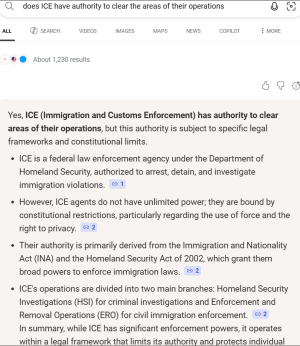

It’s not my logic it’s the law. Agencies are granted certain authority. Which is why it’s important to show if they were impeding an arrest because then yes they would have authority to detain them. Simply being in the street with a whistle does not mean they’re impeding. Which again courts have ruled is legalI disagree with your logic. They are federal law enforcement. It would seem that they get the same authorities over their operational scenes as other law enforcement, unless you show me otherwise. And that's not even considering whether it was ICE or HLS/HSI.
I didn't say it was wrong. I said that it was self-referentially incomplete. Likewise, it's funny now that you were using AI then when it was... yadda, yadda, yadda.
Like I said, it'll take more than your hand waving to convince me otherwise when I've taken the time to (alert! Appeal to Authority!) hear what experts on the matter say, and then when my superficial searches seem to contradict your hand-waving. If you find a statute that states that ICE/DHS do not get the same authorities over their operational scenes as other Law Enforcement, I'll listen, research it, and amend my opinion.
Otherwise, I'll invite you to find the next group of squad cars that are arresting some stranger, roll up on their shoulders, scream in their ears, and repeatedly ignore their orders to back off. If that doesn't give you enough excitement, do it armed.
Test your theories, hombre.
ChatGPT. Make sure to ask it for actual laws and statues and they’ll link themThank you. Looks like I have some research to do. There seems to be a conflict of AI responses. What search query did you use for that?
It’s not my logic it’s the law. Agencies are granted certain authority. Which is why it’s important to show if they were impeding an arrest because then yes they would have authority to detain them. Simply being in the street with a whistle does not mean they’re impeding. Which again courts have ruled is legal
See my edit. I am not saying that they have authority of general crowd control. That's why the NG guard was brought in for that. I am saying that they have the authority to clear their immediate area of operations, similar to a police officer telling a passenger to get back in the car while they are dealing with the driver, or officers telling you to back of if you walk up on them while they are trying to arrest someone. And that's what the agents seemed to have been doing in this case. They were not dispersing the crowd. They were removing specific individuals from the imediate vicinity of their operations.ChatGPT. Make sure to ask it for actual laws and statues and they’ll link them


It authorizes what their scope is. It also delineates what their scope isn't. But I didn't see anything limiting their scope when a serious crime is witnessed. Our discussion was about car theft. But I think it is more clear when we talk about crimes bringing harm to people rather than property crimes.In what context? I missed that and am interested.


