Too much ice

We've had amnesty previously with a promise to fix immigration. It is the easy, political, kick-the-can-down-the-road solution. So, it will probably happen again.

But it needs to be solution first and amnesty after.

I don't disagree. I think any amnesty legislation must be included in defining birthright citizenship to having 1 parent a US citizen and fixing the legal immigration process.
 
I think amnesty should look something like this:

Of course any felony conviction, known gang member, on the public dole ext is an automatic disqualifier for amnesty.
You illegally came here, overstayed your visa or whatever after you were 18 you could qualify for permanent residency with no path towards citizenship. Sorry, you broke our laws getting/living here so you cannot be a citizen.
Brought here by your parents before your 18th birthday (Dreamer), finished school, working or served in the military you have a path towards citizenship. Paths and length of time it takes may vary.
It seems that the best way to stop something you don't want to happen is to normalize and reward it.
 
We've had amnesty previously with a promise to fix immigration. It is the easy, political, kick-the-can-down-the-road solution. So, it will probably happen again.

But it needs to be solution first and amnesty after.
It seems that the best way to stop something you don't want to happen is to normalize and reward it.
 
I always understood the non-aggression pact to have been agreed for military purposes. Hitler didn't want to fight Russia and on the Western Front concurrently and Stalin wanted time to strengthen the Soviet military.
The Nazis didn't go after the capitalists other than some who couldn't compete under wartime production rules. They and the major capitalists were tight. That bailout in the early 30's kept them going and they returned the favor with labor and other laws which were very beneficial to industrialists. Krupp, Siemens, IG Farben, etc. all thrived during the Reich.
The allies weren't going to jump in to help the Russians if they were the only ones attacked. Hitler chose his opponents and chose to go after the more capitalist west, instead of the socialist east. there was no similar deal offered to the west, with non aggression and trade on the table.

they all thrived making wartime goods, not just doing what they had been. each one of the listed had Nazi finger prints all over them, not the other way around.
Krupp was always an arms manufacturer.
Siemens was electrical but was forced by the Nazis to expand into medical, and eventually arms. Some of their expansion came from the forced closures of other pre-Nazi companies like Reinger and Werke.
IG Farben was a chemical company whose big change was producing the gas used in the Holocaust.

and you are forgetting all of the foreign capitalists they stole from. Like Ford-Werke (notice the merger I mentioned up above), GM/Opel, and even the aranayanization of all the jewish, and other undesirable holdings. if it was really the industrialists making the decisions none of them would have been impacted. as I stated the important part wasn't the capitalist/industrialist angle, it was the party angle. if you worked for the party you were fine. that is not the industrialists making the decision.
 
Do you think maybe the socialists call them right to put some distance...?

lol

Sounds like your arguments have basically boiled down to appeals to dogmatic authority and attack-the-man.

All you've done is recycle the same things:

Trust me, not their words and policies.

I was assured by that group's dogma.

They didn't like Communists (no matter how much they resembled communists), so there's your proof that they were right wing.


I've done the legwork to support my argument. You've done jack ****.
I don't need to do legwork to support my position. It's common knowledge, like Genghis Kahn being aggressive.
Actually, you've done worse than nothing. You've agreed with my initial premise while claiming to argue against it. You've already admitted that fascism started as a socialist (leftist) movement. Why are you wasting everyone's time?
At issue is what it is now and what it was when Fascists gained power in Europe, far right. The initial premise wasn't what it started as but what it became.
You seem to prove that they started as socialist and moved right--with the proof seeming to be that they hated Communists (while claiming to hate capitalists more). WTH, man? Hating one wing of socialists doesn't mean you're moved to the right. It just means that you disagree with how socialism should be implemented.
That's your position. I didn't prove it. I said that after its ideological shift it was rightist.
 
The allies weren't going to jump in to help the Russians if they were the only ones attacked. Hitler chose his opponents and chose to go after the more capitalist west, instead of the socialist east. there was no similar deal offered to the west, with non aggression and trade on the table.

they all thrived making wartime goods, not just doing what they had been. each one of the listed had Nazi finger prints all over them, not the other way around.
Krupp was always an arms manufacturer.
Siemens was electrical but was forced by the Nazis to expand into medical, and eventually arms. Some of their expansion came from the forced closures of other pre-Nazi companies like Reinger and Werke.
IG Farben was a chemical company whose big change was producing the gas used in the Holocaust.

and you are forgetting all of the foreign capitalists they stole from. Like Ford-Werke (notice the merger I mentioned up above), GM/Opel, and even the aranayanization of all the jewish, and other undesirable holdings. if it was really the industrialists making the decisions none of them would have been impacted. as I stated the important part wasn't the capitalist/industrialist angle, it was the party angle. if you worked for the party you were fine. that is not the industrialists making the decision.
I saw a FB meme just this morning that went something like: "One of the surreal facts of aging is being confidently lectured by a young person about events I lived through and vividly remember."
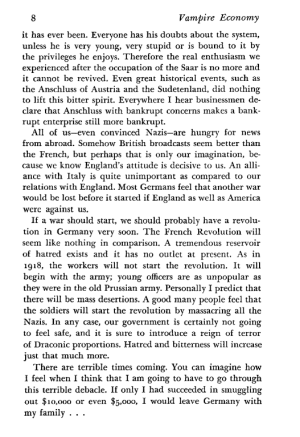
Attacking the messenger (mises) aside, the article I lined and quoted was actually heavily quoting Hans Steinicke, a (German economist who lived through it and then documented it in detail in Vampire Economy: Doing Business under Fascism (1939)).

Here is the letter in the book, quoted in the article (prefaced by a few of the author's words):
1769020866432.png
1769020897974.png
1769020924601.png
1769020988537.png
1769021014045.png
1769021039112.png
 
The allies weren't going to jump in to help the Russians if they were the only ones attacked. Hitler chose his opponents and chose to go after the more capitalist west, instead of the socialist east. there was no similar deal offered to the west, with non aggression and trade on the table.
Britain and France had a pact with Poland. Hitler had to know it was likely they'd declare war. He didn't want to be fighting Russia too. The non-aggression pack was for international strategy and not to buy time for domestic housekeeping.
they all thrived making wartime goods, not just doing what they had been. each one of the listed had Nazi finger prints all over them, not the other way around.
Krupp was always an arms manufacturer.
Siemens was electrical but was forced by the Nazis to expand into medical, and eventually arms. Some of their expansion came from the forced closures of other pre-Nazi companies like Reinger and Werke.
IG Farben was a chemical company whose big change was producing the gas used in the Holocaust.

and you are forgetting all of the foreign capitalists they stole from. Like Ford-Werke (notice the merger I mentioned up above), GM/Opel, and even the aranayanization of all the jewish, and other undesirable holdings. if it was really the industrialists making the decisions none of them would have been impacted. as I stated the important part wasn't the capitalist/industrialist angle, it was the party angle. if you worked for the party you were fine. that is not the industrialists making the decision.
And industrialists thrived under the Reich. Didn't Ford and Opel continue doing business in Germany during the war, because they were making money?
 
I've stated my views for years, yet I'm constantly accused of advocating for open borders.

Yes, citizenship/visas are earned. No, spending billions on these mass deportations of non violent people isn't good for the economy.
How do you feel about expedited pathways for permanent residency (working, non-violent, etc)? To at least bring safe, productive people into the light.

Not sure I’m onboard with expedited citizenship.
 
How do you feel about expedited pathways for permanent residency (working, non-violent, etc)? To at least bring safe, productive people into the light.

Not sure I’m onboard with expedited citizenship.
That's totally fine. Happy medium between full unconditional amnesty and whatever the **** the past year is.
 
  • Like
Reactions: 85SugarVol
I don't need to do legwork to support my position. It's common knowledge, like Genghis Kahn being aggressive.

Yes, that "dogma" you keep appealing to.

At issue is what it is now and what it was when Fascists gained power in Europe, far right. The initial premise wasn't what it started as but what it became.

That's your position. I didn't prove it. I said that after its ideological shift it was rightist.

See my most recent (and likely future) post(s) on the matter. From contemporary descriptions, it was a socialist/collectivist, centrally controlled economy--little different from Communism in practice, with "private industry" and "personal property" rights in name only. And the descriptions make it VERY clear that the Nazi/Fascists were in complete power. The funny thing is that the brutal totalitarian nature of the ideology was the mechanism by which the "collectivist" parts of the ideals were inforced.


1769022241274.png

1769022265040.png

1769022330982.png

The irony is that your claims appear to be just the opposite of contemporary testimony. You say that they claimed to be socialist, but were lying. It would appear, to the contrary, that any claim of right-leaning principals were lies. Again, they feigned right-leaning ideals, but used their totalitarian control to enforce a state-directed, collectivist economy with the state blatantly controlling production, and their actions proving no real existence of private property rights.
 
Last edited:
...

And industrialists thrived under the Reich. Didn't Ford and Opel continue doing business in Germany during the war, because they were making money?
From an eye witness:

1769022711081.png

Were they successful in spite of the Reich, or because they surrendered to its control? The answer to that will define whether it was a capitalist endeavor, or socialist/collectivist, planned economy. It's likely a failed endeavor to "judge by American standards".

1769023085690.png
1769023161308.png
 
Last edited:
Ah, the Mises Institute, that explains quite a bit. Messrs. Mises, Rothbard and Rockwell weren't afraid to go against the grain were they? Do you think maybe the Austrian School folks call the Nazis Leftists to put some distance between the two philosophies?
Here's a different take on the dynamic between industrialists and the Party in Nazi Germany:
that doesn't really say what you think its saying. throughout it points out that the industries reported to the Nazis, never the other way around.

"During the era of the Great Depression in 1932, the German state held majority stakes within conglomerates such as Gelsenkirchener Bergwerks,"

"Additionally, banks such as Danat Bank and Dresdner Bank were merged and nationalized"

"A key tenet of the Nazi economy after 1936 was a policy of autarky, or self-sufficiency, deemed as necessary for a war economy and promoted by Adolf Hitler and Hermann Göring under the Four Year-Plan."

"Raw materials needed for war include rubber, iron, and fuel, all of which was requested by the Nazi regime towards industrialists and corporations who obliged, save for Ruhr manufacturers who initially opposed Hermann Göring’s demands due to a lack of economic viability." you think those other industrialists were going along with policy that lacked economic viability because they were industrialists, or because they were Nazis?

"Therefore, businesses which could not fulfill Nazi economic policy were nationalized, while those which could accomplish Nazi objectives willingly collaborated as a return of the favor from re-privatization, as well as lucrative prospects via rearmament."

"Ferdinand Porsche was one such industrialist who willingly supported the Nazis in fulfilling their plans and goals. Porsche, a Czech automotive engineer who became a member of the Nazi Party in 1937, was ordered by Hitler to create a “people’s car” (Volkswagen), promoted via the Strength through Joy (KdF) campaign to garner working class support." what the industrialists who worked with Hitler were Nazis? Who has been pointing that out I wonder?

"Considering that the Nazi economy was primarily devoted to war and rearmament, Nazi control over corporations loosened, but corporations and conglomerates still did the bidding of the state."

"The previously mentioned ousting of Jews in the workplace took place on November 12, 1938, with Jewish-owned and operated businesses liquidated and nationalized while Jewish managers were fired (Stackelberg and Winkle, document 4.13d)."

"In conclusion, National Socialism would not have been as possible without the complicity, forced or otherwise, of industry and big business. The reality is that many German and international corporations fulfilled Nazi wishes, including persecution, exploitation, and genocide of the Jews and other “racially undesirable” peoples. "

no where does it state, or even begin to suggest, that Nazi Germany was a corporate state. its says throughout that industrialists who chose to work with the Nazis were rewarded, largely the party members; and those who didn't were forcibly closed.

The Nazis didn't work with all industrialists. they worked with the industrialists who aligned with their policy. Nazi>Industrialist.

even when they talk about privatizing certain aspects it was to Nazis/Nazi aligned, not just to industrialists.

 
  • Like
Reactions: Orange_Crush
I don't need to do legwork to support my position. It's common knowledge, like Genghis Kahn being aggressive.
it would be more like saying Genghis Kahn was just a blood thirsty warlord. ignoring the reform policies and empire building he did.

as I said earlier, you are oversimplifying to make your argument.
 
  • Like
Reactions: Orange_Crush

Advertisement


Back
Top