Official Global Warming thread (merged)

November was Earth’s warmest such month on record by a huge margin

According to NASA the probability of 2015 being a record year is now >99.999%.

CWN0iW0UsAE_6fD.jpg


And according to the UK Met Office, there’s a 95% chance 2016 will beat 2015.
 
  • Like
Reactions: 2 people
Last edited:
  • Like
Reactions: 1 person
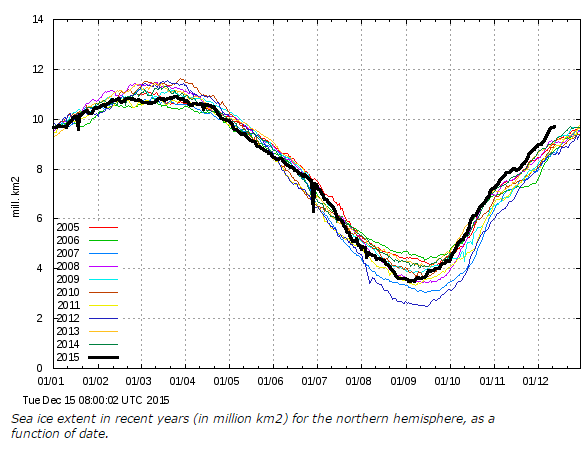
Dude your article is from March. My chart was live.

Here is yesterday's Arctic sea ice extent.

CWQesl8u8aaoimz.png:large
Where?

The yearly maximum was in March and the minimum was in September. Those are typically the figures people use to compare year to year.

The Antarctic sea ice figure is up-to-date. Here's your figure for Arctic sea ice:

N_stddev_timeseries_thumb.png
 
  • Like
Reactions: 1 person
I see you got your picture working. What's the source? That doesn't gel with the NSIDC's numbers...
Esa's Cryosat sees Arctic sea-ice volume bounce back - BBC News

The bounce back in the extent of sea ice in the Arctic this summer was reflected also in the volume of ice.
Data from Europe's Cryosat spacecraft suggests there were almost 9,000 cu km of ice at the end of this year's melt season.
This is close to 50% more than in the corresponding period in 2012.
As your article points out, that 50% increase was against a record low in 2012. But more importantly, how are you gonna complain about my articles from earlier this year when you're posting one from 2013?! Here's some more recent news:

Warmer air and sea, declining ice continue to trigger Arctic change
"Now in its 10th year, the Arctic Report Card is a key tool to understanding changes in the Arctic and how those changes may affect communities, businesses, and people around the world," said NOAA Chief Scientist Dr. Rick Spinrad, during a press conference today at the annual American Geophysical Union Fall Meeting in San Francisco. "The Arctic is warming twice as fast as other parts of the planet, which has ramifications for global security, climate, commerce, and trade. This year's report shows the importance of international collaboration on sustained, long-term observing programs that provide insights to inform decisions by citizens, policymakers, and industry."

Some 70 authors from 10 countries, including U.S. federal agencies and academics, contributed to this annual peer-reviewed report, guided by an editorial team from the Office of Naval Research, the US Army Corps of Engineers' Cold Regions Research and Engineering Laboratory, and NOAA. This year's report features updates on key indicators as well as new reports on the status of walrus, the northward movement of fishes, increasing river discharge into the Arctic Ocean, and the importance of community-based monitoring. Major findings of this year's report include:

-- Air temperature: The average annual air temperature over land areas between October 2014 and September 2015 was 2.3 degrees Fahrenheit (1.3 degrees Celsius) above average, the highest in the observational record which began in 1900, and is a 5.4 degrees Fahrenheit (3 degrees Celsius) increase since the beginning of the 20th Century.
-- Sea ice: Maximum Arctic Ocean sea ice extent, which occurred February 25, 2015, 15 days earlier than average, was the lowest extent recorded since records began in 1979. Minimum sea ice extent measured on September 11, 2015, was the fourth lowest in the satellite record since 1979. Arctic minimum sea ice extent has been declining at a rate of 13.4% per decade (relative to the 1981-2010 average). First year ice now dominates the winter ice cover, comprising about 70 percent of the March 2015 ice pack, compared to about half that in the 1980s when older, thicker ice was more prevalent. The thinner, younger ice is more vulnerable to melting in the summer.

On a side note, climatologists also predicted polar amplification (the fact that the Arctic is warming at a much higher rate than the rest of the planet) several decades ago. Check out the picture in the hottest November article!

And on a less related note, I'm disappointed I didn't get to attend the AGU conference both of our articles refer to this year. I'm a co-author on a poster and talk being presented tomorrow. I intended to go but had some graduations and other obligations so the timing didn't work out :hmm:
 
  • Like
Reactions: 2 people
Bart's flailing about now folks. He must be having Post Paris Traumatic Stress Syndrome. And, the hits just keep on coming for Bart and his like minded Marxists. There was NYC, and then Washington DC and then the Papal Enclave and now Paris. Just Damn. Nobody believes the crap anymore but Bart being the programmed little propagandist that he is keeps on a chugging. The little Marxist who could.
 
Troposphere says no.
Did you miss these posts? Even UAH’s analysis of the troposphere says yes.
Bart's flailing about now folks. He must be having Post Paris Traumatic Stress Syndrome. And, the hits just keep on coming for Bart and his like minded Marxists. There was NYC, and then Washington DC and then the Papal Enclave and now Paris. Just Damn. Nobody believes the crap anymore but Bart being the programmed little propagandist that he is keeps on a chugging. The little Marxist who could.
Talk about flailing…

I’m quite happy with the outcome of the Paris summit. Have a merry white brown tornadic Christmas :peace:
 
  • Like
Reactions: 2 people
Did you miss these posts? Even UAH’s analysis of the troposphere says yes.

Talk about flailing…

I’m quite happy with the outcome of the Paris summit. Have a merry white brown tornadic Christmas :peace:

You mean the one that says 2015 is the third warmest in the satellite record? I thought the troposphere was supposed to lead?
 
If 70f on Christmas Eve costs us some low lying islands and some coastal land, it's worth it.


That's exactly what the politicians pimping climate change don't understand. Most of the population lives in areas that have below freezing temps during winter. Most of us would trade some coastal land for more mild winters and cheaper food due to longer growing seasons. Personally I would like to have a few palm trees in the backyard to give the pool area a more tropical look.

Want to see the natives get really restless, start predicting longer colder winters.
 

Advertisement


Back
Top