"Now in its 10th year, the Arctic Report Card is a key tool to understanding changes in the Arctic and how those changes may affect communities, businesses, and people around the world," said NOAA Chief Scientist Dr. Rick Spinrad, during a press conference today at the annual American Geophysical Union Fall Meeting in San Francisco. "The Arctic is warming twice as fast as other parts of the planet, which has ramifications for global security, climate, commerce, and trade. This year's report shows the importance of international collaboration on sustained, long-term observing programs that provide insights to inform decisions by citizens, policymakers, and industry."
Some 70 authors from 10 countries, including U.S. federal agencies and academics, contributed to this annual peer-reviewed report, guided by an editorial team from the Office of Naval Research, the US Army Corps of Engineers' Cold Regions Research and Engineering Laboratory, and NOAA. This year's report features updates on key indicators as well as new reports on the status of walrus, the northward movement of fishes, increasing river discharge into the Arctic Ocean, and the importance of community-based monitoring. Major findings of this year's report include:
-- Air temperature: The average annual air temperature over land areas between October 2014 and September 2015 was 2.3 degrees Fahrenheit (1.3 degrees Celsius) above average, the highest in the observational record which began in 1900, and is a 5.4 degrees Fahrenheit (3 degrees Celsius) increase since the beginning of the 20th Century.
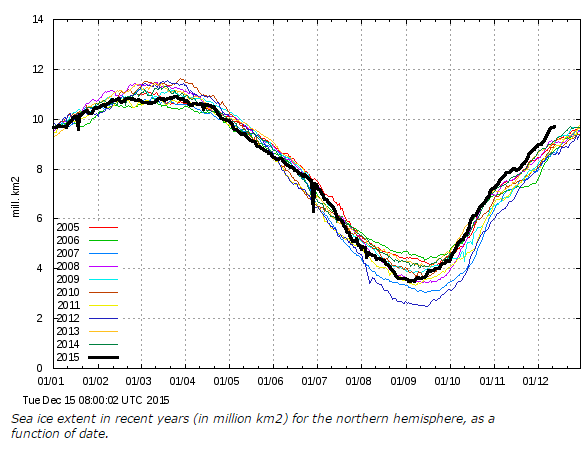
-- Sea ice: Maximum Arctic Ocean sea ice extent, which occurred February 25, 2015, 15 days earlier than average, was the lowest extent recorded since records began in 1979. Minimum sea ice extent measured on September 11, 2015, was the fourth lowest in the satellite record since 1979. Arctic minimum sea ice extent has been declining at a rate of 13.4% per decade (relative to the 1981-2010 average). First year ice now dominates the winter ice cover, comprising about 70 percent of the March 2015 ice pack, compared to about half that in the 1980s when older, thicker ice was more prevalent. The thinner, younger ice is more vulnerable to melting in the summer.