
Official Global Warming thread (merged)

Regardless of whether water privatization would have been better, today we’re consuming water at an unsustainable rate. Do you think the government will be justified in implementing further water restrictions if trends continue?

I’m testing your unfettered free market utopia. Will you admit there is a role for government in such issues?

You're asking me if an unfettered free market can fix the problem way after the fact? You need to go to the Mises.org and read some of the essays about the drought situation. Many of those authors believe free market is the solution. Justification isn't really the right word. I mean that is what governments do. That is what they understand. Were the Soviets justified in rationing toilet paper and bread to their citizens in the 1980's? Government causes the problem and then is justified for rationing for a problem they caused. Sure, I guess so.
 
  • Like
Reactions: 1 person
Sure. Some notable ones include:

• Anthropogenic CO2 – We’ve witnessed an increase in atmospheric CO2 (specifically the isotope from fossil fuel combustion ) and decrease in O2 So to get more O2 shouldn't we want more CO2?
• Global warming -- surface temperatures, atmospheric temperatures, and ocean heat content have all increased from fossil fuel combustion (predicted over 100 years ago)Very little warming. Cherry picked data.
• Stratospheric cooling – the stratosphere and upper atmosphere are cooling
• Rising tropopause – the boundary between the troposphere and stratosphere is rising
• Decreasing diurnal temperature range – the planet has been warming more at night than during the day Hasn't temperature range always fluctuated?
• Arctic amplification – temperatures have been increasing faster at high latitudes than low latitudes Like the Medieval Warming Period?
• Increasing downward IR radiation and decreasing outward IR radiationBS
• Increasing atmospheric H2O (and thereby increasing the water vapor greenhouse effect)
BS.
• Arctic sea ice is melting (faster than IPCC projections)And, Antarctic Sea Ice increasing.
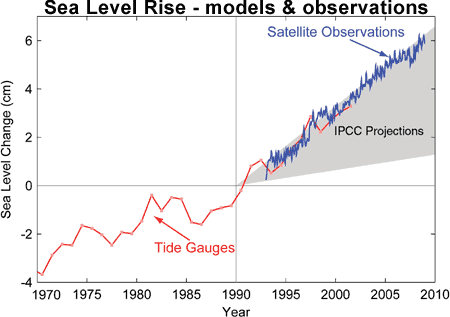
• Sea level is rising (faster than IPCC projections) and seawater is intruding into freshwater BS
• Sea level rise (and melting permafrost, decreasing sea ice) is increasing coastal erosion and coastal floodingBS
• Weakening thermohaline circulationThermowhat?
• Increasing drought and wildfires in the Western US More BS

The list goes on. Now can you finally provide an example of a phony environmental doomsday prediction endorsed by the majority of the scientific community? Or will you just keep playing this game?

And, more BS.
 
  • Like
Reactions: 1 person
The cost of water will go up to reflect it's demand, and somebody will provide desalination.

Edit: Nuclear powered desalination, two birds one stone.

They'll go after nuclear power after they have gotten rid of all the coal fired plants.
 
  • Like
Reactions: 1 person
Sure. Some notable ones include:

• Anthropogenic CO2 – We’ve witnessed an increase in atmospheric CO2 (specifically the isotope from fossil fuel combustion ) and decrease in O2
• Global warming -- surface temperatures, atmospheric temperatures, and ocean heat content have all increased from fossil fuel combustion (predicted over 100 years ago)
• Stratospheric cooling – the stratosphere and upper atmosphere are cooling
• Rising tropopause – the boundary between the troposphere and stratosphere is rising
• Decreasing diurnal temperature range – the planet has been warming more at night than during the day
• Arctic amplification – temperatures have been increasing faster at high latitudes than low latitudes
• Increasing downward IR radiation and decreasing outward IR radiation
• Increasing atmospheric H2O (and thereby increasing the water vapor greenhouse effect)
• Arctic sea ice is melting (faster than IPCC projections)
• Sea level is rising (faster than IPCC projections) and seawater is intruding into freshwater
• Sea level rise (and melting permafrost, decreasing sea ice) is increasing coastal erosion and coastal flooding
• Weakening thermohaline circulation
• Increasing drought and wildfires in the Western US

The list goes on. Now can you finally provide an example of a phony environmental doomsday prediction endorsed by the majority of the scientific community? Or will you just keep playing this game?

.
 

Attachments

  • FB_IMG_1426304084211.jpg
    FB_IMG_1426304084211.jpg
    39.2 KB · Views: 0
You of course can cite all these instances? I mean, you aren't the only one allowed to demand proof.

And how many of these are scientific observations as opposed to predictions?
Well they were all predictions before they became observations. Lower atmosphere warming/upper atmosphere cooling, rising tropopause, decreasing diurnal temperature range, and changes in the radiative flux are basic consequences specific to greenhouse gas – induced climate change. Others are not GHG-specific but were accurate climate change predictions nonetheless.

While there was earlier work on greenhouse gases and climatic implications, I believe Svante Arrhenius is credited with being the first person to predict that the rise in atmospheric CO2 from fossil fuel combustion would lead to global warming back in 1896. The Charney Report is one of the earliest assessment of the scientific literature on global warming in 1979. It’s brief but mentions arctic amplification, increasing water vapor effects, and change in radiative flux (it also cites papers that talk about other phenomena I listed [e.g. Ramanthan 1978 & '79]). Here are some more papers on the topics. Most are publicly available. We can go into detail if there’s one you’re particularly interested in.

Stable isotope ratio mass spectrometry in global climate change research
The Distribution of Carbon Dioxide Cooling in the Lower Stratosphere
Stratospheric Temperature Trends: Observations and Model Simulations
Global Change in the Upper Atmosphere
A Search for Human Influences on the Thermal Structure of the Atmosphere
Diurnal temperature range as an index of global climate change during the twentieth century
Observational determination of surface radiative forcing by CO2 from 2000 to 2010
Causal Feedbacks in Climate Change
Upper Tropospheric Moistening in response to Anthropogenic Warming
Global Warming and Coastal Erosion
Encroaching Tides: How Sea Level Rise and Tidal Flooding Threaten U.S. East and Gulf Coast Communities over the Next 30 Years
Exceptional twentieth-century slowdown in Atlantic Ocean overturning circulation
Climate and Wildfire in the Western United States
Warming and Earlier Spring Increase Western U.S. Forest Wildfire Activity

Arctic sea ice loss and sea level rise are occurring faster than projected by the IPCC’s third assessment report:

IPCC_model_vs_obs_sea_ice.png


SLR_models_obs.gif


Now will you answer my question?
 
  • Like
Reactions: 1 person
You're asking me if an unfettered free market can fix the problem way after the fact? You need to go to the Mises.org and read some of the essays about the drought situation. Many of those authors believe free market is the solution. Justification isn't really the right word. I mean that is what governments do. That is what they understand. Were the Soviets justified in rationing toilet paper and bread to their citizens in the 1980's? Government causes the problem and then is justified for rationing for a problem they caused. Sure, I guess so.
I’m asking how an unchecked free market handles environmental degradation. For example, last year California passed groundwater regulation allowing local agencies to manage groundwater extraction. Before, pumping by farmers had become an arms race. Another example is the inefficient use of water to support their plush lifestyle and water-intensive crops. The market demands almonds! But now the government wants to step in and tell people they need to change? The government wants to "protect the environment" at the expense of short-term economic growth?! What an outrage!

Look, I’m not opposed to the concept of water privatization per se (although most of what I’ve read on the topic indicates it’s more-or-less a wash in terms of rates and efficiency). A quick search on Mises.org only returned one unconvincing article. If you can make a strong argument for water privatization I will listen. I just think this is another example of where the ideal of anarchy fails. There needs to be some oversight to make sure our natural resources are being used responsibly.

And to tie this back into the thread, I’m basically mimicking an earlier question that’s gone unanswered. How does an unchecked free market stop global warming? I know you deny the problem, but for the sake of argument let’s just assume that the scientific community is correct.
And, more BS.
Funny
Look up imbecile in the dictionary and you'll see you know whose picture beside the definition.

https://gma.yahoo.com/obama-says-cl...-personal-him-100124762--abc-news-health.html
Check this alarmist article from Fox News:

Is climate change really killing us? A doctor's diagnosis
 
  • Like
Reactions: 2 people
Now will you answer my question?

Likely not.

It's funny how tenured scientists in significant positions at highly credible universities are suddenly "on the fringe" when it comes to predictions of climate science. Disavowing them is a smart move.
 
I’m asking how an unchecked free market handles environmental degradation. For example, last year California passed groundwater regulation allowing local agencies to manage groundwater extraction. Before, pumping by farmers had become an arms race. Another example is the inefficient use of water to support their plush lifestyle and water-intensive crops. The market demands almonds! But now the government wants to step in and tell people they need to change? The government wants to "protect the environment" at the expense of short-term economic growth?! What an outrage!

Look, I’m not opposed to the concept of water privatization per se (although most of what I’ve read on the topic indicates it’s more-or-less a wash in terms of rates and efficiency). A quick search on Mises.org only returned one unconvincing article. If you can make a strong argument for water privatization I will listen. I just think this is another example of where the ideal of anarchy fails. There needs to be some oversight to make sure our natural resources are being used responsibly.

And to tie this back into the thread, I’m basically mimicking an earlier question that’s gone unanswered. How does an unchecked free market stop global warming? I know you deny the problem, but for the sake of argument let’s just assume that the scientific community is correct.

Funny

Check this alarmist article from Fox News:

Is climate change really killing us? A doctor's diagnosis

Not only do I not think it is a problem but I don't think it is real. And, by scientific community do you mean the UN? But, if we go with your premise that it is real and it is a problem then John Stossel explains the free market approach well:

Another global warming skeptic has dared speak up. Meteorologist John Coleman, founder of the Weather Channel, calls global warming “the greatest scam in history.”

“Environmental extremists,” he writes, “notable politicians among them ... create this wild ‘scientific’ scenario of the civilization threatening environmental consequences from Global Warming unless we adhere to their radical agenda. ...
“I have read dozens of scientific papers. I have talked with numerous scientists. ...There is no runaway climate change. The impact of humans on climate is not catastrophic. Our planet is not in peril. ... In time, a decade or two, the outrageous scam will be obvious.”

Meteorologist and Weather Channel founder John Coleman

I suspect he’s right.

But what if he’s wrong?

I’ve argued that even if global warming is something to worry about, it’s dangerous to look to government to fix the climate.

Government is a blunt instrument, riddled with self-serving politics and special-interest pandering.

To expect it to do something as complicated as calibrate regulations and taxes to fine-tune the climate — without making many people poorer and a few cronies richer —is naive.

But that doesn’t mean we can do nothing. We have a powerful generator of solutions if we let it work: the free market.

The market has solved environmental problems many times in the past. Before the automobile, America’s cities suffered from a terrible pollutant. It bred disease and emitted noxious odors.

It was horse manure.

As economist Nobel laureate Robert Fogel said, “There were 200,000 horses in New York City at the beginning of the 20th century defecating everywhere. ... When you walked around ... you were breathing pulverized horse manure.” From such air and water pollution, people contracted cholera, typhoid and other deadly diseases.

When the internal-combustion engine came along, the air and ground became much cleaner. Environmentalists romanticize the days before the car, but who wants to go back to that filth and disease?

How might the free market — which relies on consent, not coercion — be better than government at addressing global warming? Policy analyst Gene Callahan points out that government is a big part of the problem because it encourages overuse of fossil fuels.

For example, use of highways is not subject to market pricing, so it appears to be free. The resulting traffic jams are bad for the environment.

We’d use less coal if the government didn’t create regulatory obstructions to nuclear power.

The creative market process — if unburdened by state subsidies and regulations — would discover alternative fuels that bureaucrats can’t even dream of.

Today, an energy maverick is likely to be punished by the government, as Bob Teixeira learned when he had the audacity to run his Mercedes on soybean oil. If climate danger is real, the profit motive will drive entrepreneurs to find technologies to reduce CO2.

Markets outshine governments in innovation and flexibility. Those virtues would come into play if global warming does become a problem. “For example, the financial industry, by creating new securities and derivative markets, could crystallize the ‘dispersed knowledge’ that many different experts held in order to coordinate and mobilize mankind’s total response to global warming,” writes Callahan.

“Weather futures can serve to spread the risk of bad weather beyond the local area affected. Perhaps there could arise a market betting on the areas most likely to be permanently flooded. That may seem ghoulish, but by betting on their own area, inhabitants could offset the cost of relocating should the flooding occur.”

American political scientist Aaron Wildavsky (1930-1993)

A less-regulated insurance industry would have a strong profit motive to anticipate problems from any warming and set prices for property coverage appropriately.

Insurance companies would rely on the best scientific information because, unlike government, if they make a mistake, they face bankruptcy.

The most important thing we can do is not to impede production of wealth.

As the late Aaron Wildavsky said in his wonderful book Searching for Safety, “Wealthier is healthier.” A rich society is resilient and able to respond to unforeseen threats.
People in the developing world desperately need prosperity. Blocking their development on the flimsy promise of climate “fixes” will only make hard lives harder. Their primitive environments are killing them.
 
Last edited:
  • Like
Reactions: 1 person
Well they were all predictions before they became observations. Lower atmosphere warming/upper atmosphere cooling, rising tropopause, decreasing diurnal temperature range, and changes in the radiative flux are basic consequences specific to greenhouse gas – induced climate change. Others are not GHG-specific but were accurate climate change predictions nonetheless.

While there was earlier work on greenhouse gases and climatic implications, I believe Svante Arrhenius is credited with being the first person to predict that the rise in atmospheric CO2 from fossil fuel combustion would lead to global warming back in 1896. The Charney Report is one of the earliest assessment of the scientific literature on global warming in 1979. It’s brief but mentions arctic amplification, increasing water vapor effects, and change in radiative flux (it also cites papers that talk about other phenomena I listed [e.g. Ramanthan 1978 & '79]). Here are some more papers on the topics. Most are publicly available. We can go into detail if there’s one you’re particularly interested in.

Stable isotope ratio mass spectrometry in global climate change research
The Distribution of Carbon Dioxide Cooling in the Lower Stratosphere
Stratospheric Temperature Trends: Observations and Model Simulations
Global Change in the Upper Atmosphere
A Search for Human Influences on the Thermal Structure of the Atmosphere
Diurnal temperature range as an index of global climate change during the twentieth century
Observational determination of surface radiative forcing by CO2 from 2000 to 2010
Causal Feedbacks in Climate Change
Upper Tropospheric Moistening in response to Anthropogenic Warming
Global Warming and Coastal Erosion
Encroaching Tides: How Sea Level Rise and Tidal Flooding Threaten U.S. East and Gulf Coast Communities over the Next 30 Years
Exceptional twentieth-century slowdown in Atlantic Ocean overturning circulation
Climate and Wildfire in the Western United States
Warming and Earlier Spring Increase Western U.S. Forest Wildfire Activity

Arctic sea ice loss and sea level rise are occurring faster than projected by the IPCC’s third assessment report:

IPCC_model_vs_obs_sea_ice.png


SLR_models_obs.gif


Now will you answer my question?

So, they take the sea level rise that has been occurring since the end of the last glacial and project it out and they are great prognosticators? And, arctic sea ice has come and gone for millions of years but now we have to stop this natural cycle? You're not making any sense.
 
Likely not.

It's funny how tenured scientists in significant positions at highly credible universities are suddenly "on the fringe" when it comes to predictions of climate science. Disavowing them is a smart move.
What predictions again?

I’m not disavowing anyone. Everyone has ideas that turn out to be wrong. If a bad idea is put forth it and does not withstand the scrutiny of the scientific community it will fall by the wayside. Unlike those ideas, the consensus around anthropogenic climate change has only grown stronger and stronger over decades of research.

You must get the difference by now. This crap is getting old. If the debate ends here, your effort falls short of SandVol’s. Maybe even BigOrangeTrain’s
 
  • Like
Reactions: 1 person
Lots of rhetoric but lacking in answers or concrete suggestions. Interesting nonetheless
…But that doesn’t mean we can do nothing. We have a powerful generator of solutions if we let it work: the free market.

The market has solved environmental problems many times in the past.

How might the free market — which relies on consent, not coercion — be better than government at addressing global warming?
So what exactly is your problem with market-based tools like cap-and-trade which, as you correctly point out, has solved environmental problems many times in the past? It was crafted by Reagan Republicans!
A less-regulated insurance industry would have a strong profit motive to anticipate problems from any warming and set prices for property coverage appropriately.

Insurance companies would rely on the best scientific information because, unlike government, if they make a mistake, they face bankruptcy.
We agree again! It’s funny because some of the leading insurance and reinsurance firms are quite vocal about climate change.

We should not be encouraging risky behavior through subsidies like the federal crop and flood insurance programs.
The most important thing we can do is not to impede production of wealth.

As the late Aaron Wildavsky said in his wonderful book Searching for Safety, “Wealthier is healthier.” A rich society is resilient and able to respond to unforeseen threats.
People in the developing world desperately need prosperity.
So what you’re saying is we should pump as much groundwater as we can as fast as we can, amiright? Drill, baby, drill!
 
  • Like
Reactions: 3 people
Well they were all predictions before they became observations. Lower atmosphere warming/upper atmosphere cooling, rising tropopause, decreasing diurnal temperature range, and changes in the radiative flux are basic consequences specific to greenhouse gas – induced climate change. Others are not GHG-specific but were accurate climate change predictions nonetheless.

While there was earlier work on greenhouse gases and climatic implications, I believe Svante Arrhenius is credited with being the first person to predict that the rise in atmospheric CO2 from fossil fuel combustion would lead to global warming back in 1896. The Charney Report is one of the earliest assessment of the scientific literature on global warming in 1979. It’s brief but mentions arctic amplification, increasing water vapor effects, and change in radiative flux (it also cites papers that talk about other phenomena I listed [e.g. Ramanthan 1978 & '79]). Here are some more papers on the topics. Most are publicly available. We can go into detail if there’s one you’re particularly interested in.

Stable isotope ratio mass spectrometry in global climate change research
The Distribution of Carbon Dioxide Cooling in the Lower Stratosphere
Stratospheric Temperature Trends: Observations and Model Simulations
Global Change in the Upper Atmosphere
A Search for Human Influences on the Thermal Structure of the Atmosphere
Diurnal temperature range as an index of global climate change during the twentieth century
Observational determination of surface radiative forcing by CO2 from 2000 to 2010
Causal Feedbacks in Climate Change
Upper Tropospheric Moistening in response to Anthropogenic Warming
Global Warming and Coastal Erosion
Encroaching Tides: How Sea Level Rise and Tidal Flooding Threaten U.S. East and Gulf Coast Communities over the Next 30 Years
Exceptional twentieth-century slowdown in Atlantic Ocean overturning circulation
Climate and Wildfire in the Western United States
Warming and Earlier Spring Increase Western U.S. Forest Wildfire Activity

Arctic sea ice loss and sea level rise are occurring faster than projected by the IPCC’s third assessment report:

IPCC_model_vs_obs_sea_ice.png


SLR_models_obs.gif


Now will you answer my question?

charts and graphs, charts and graphs,
 

Attachments

  • wnd_11cf12279f6c13fcfaaa803ee3c9c98e.jpg
    wnd_11cf12279f6c13fcfaaa803ee3c9c98e.jpg
    25.6 KB · Views: 0
  • Like
Reactions: 2 people
Lots of rhetoric but lacking in answers or concrete suggestions. Interesting nonetheless

So what exactly is your problem with market-based tools like cap-and-trade which, as you correctly point out, has solved environmental problems many times in the past? It was crafted by Reagan Republicans!

Nothing, if the free market determines it is necessary.

We agree again! It’s funny because some of the leading insurance and reinsurance firms are quite vocal about climate change.

We should not be encouraging risky behavior through subsidies like the federal crop and flood insurance programs.

Yes, they make money insuring risk or better yet the perception of risk.

So what you’re saying is we should pump as much groundwater as we can as fast as we can, amiright? Drill, baby, drill!

Whatever the most efficient, productive, profitable, enduring, fruitful, healthy, popular solution the free market arrives at.
 
I actually agree with Bert that the market is not currently set up well to deal with global warming. But I also know that the US government could give two craps about it. All it wants is more power, more votes, and more job openings as million dollar lobbyists.
 
I actually agree with Bert that the market is not currently set up well to deal with global warming. But I also know that the US government could give two craps about it. All it wants is more power, more votes, and more job openings as million dollar lobbyists.

And, the statist never wants to give it a chance.
 

Advertisement


Back
Top