


peaygolf
The "Fly" is open...Let's Go Peay!!!! NIL SUX A$$
- Joined
- Nov 30, 2017
- Messages
- 28,929
- Likes
- 144,872
July 15, 1799
One of the Top 10 Historical discoveries.
The discovery of the Rosetta Stone on July 15, 1799, marked a significant milestone in the understanding of ancient Egyptian civilization. Unearthed by a French soldier during Napoleon Bonaparte's campaign in Egypt, the stone features inscriptions in three scripts: Greek, hieroglyphics, and demotic, providing a key to deciphering the previously unreadable hieroglyphic writing. This basalt slab, measuring approximately 3 feet 9 inches by 2 feet 4.5 inches, became a crucial tool for scholars aiming to unlock the mysteries of ancient texts and culture.
The Rosetta Stone’s inscriptions include a decree celebrating the reign of Ptolemy V, which was written in a way that allowed researchers to compare the known Greek text with the unknown hieroglyphs. Although discovered in 1799, it took over two decades before hieroglyphics were successfully translated, thanks in large part to the efforts of scholars like Jean François Champollion and Thomas Young. Champollion's breakthroughs in understanding the phonetic aspects of hieroglyphics revived interest in Egyptology and opened the door to the study of ancient Egyptian history, culture, and language.
The stone eventually made its way to the British Museum, where it remains a focal point for Egyptological studies, symbolizing the intersection of cultural heritage and scholarly inquiry. Its discovery not only enhanced knowledge of ancient Egypt but also sparked continued interest in archaeological explorations and the preservation of Egyptian antiquities.
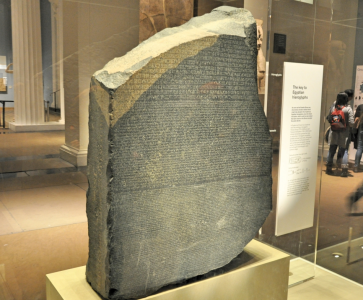
One of the Top 10 Historical discoveries.
The discovery of the Rosetta Stone on July 15, 1799, marked a significant milestone in the understanding of ancient Egyptian civilization. Unearthed by a French soldier during Napoleon Bonaparte's campaign in Egypt, the stone features inscriptions in three scripts: Greek, hieroglyphics, and demotic, providing a key to deciphering the previously unreadable hieroglyphic writing. This basalt slab, measuring approximately 3 feet 9 inches by 2 feet 4.5 inches, became a crucial tool for scholars aiming to unlock the mysteries of ancient texts and culture.
The Rosetta Stone’s inscriptions include a decree celebrating the reign of Ptolemy V, which was written in a way that allowed researchers to compare the known Greek text with the unknown hieroglyphs. Although discovered in 1799, it took over two decades before hieroglyphics were successfully translated, thanks in large part to the efforts of scholars like Jean François Champollion and Thomas Young. Champollion's breakthroughs in understanding the phonetic aspects of hieroglyphics revived interest in Egyptology and opened the door to the study of ancient Egyptian history, culture, and language.
The stone eventually made its way to the British Museum, where it remains a focal point for Egyptological studies, symbolizing the intersection of cultural heritage and scholarly inquiry. Its discovery not only enhanced knowledge of ancient Egypt but also sparked continued interest in archaeological explorations and the preservation of Egyptian antiquities.





 For some reason, back in the '50s-60s, there were a lot of best selling non-fiction books generated by archaeologic and anthropologic discoveries. Like Thor Heyerdahl's Kon-Tiki. I'd bet a bunch of y'all over age 65 read that one in your youth.

 Should I go??